
Approach

A calm, four-phase path from idea to operations.

We work in the open and in short loops. You always know what phase we are in, what we are trying to prove, and what it will take to move to the next. No mystery, no unbounded discovery, no agent thrown over a wall.

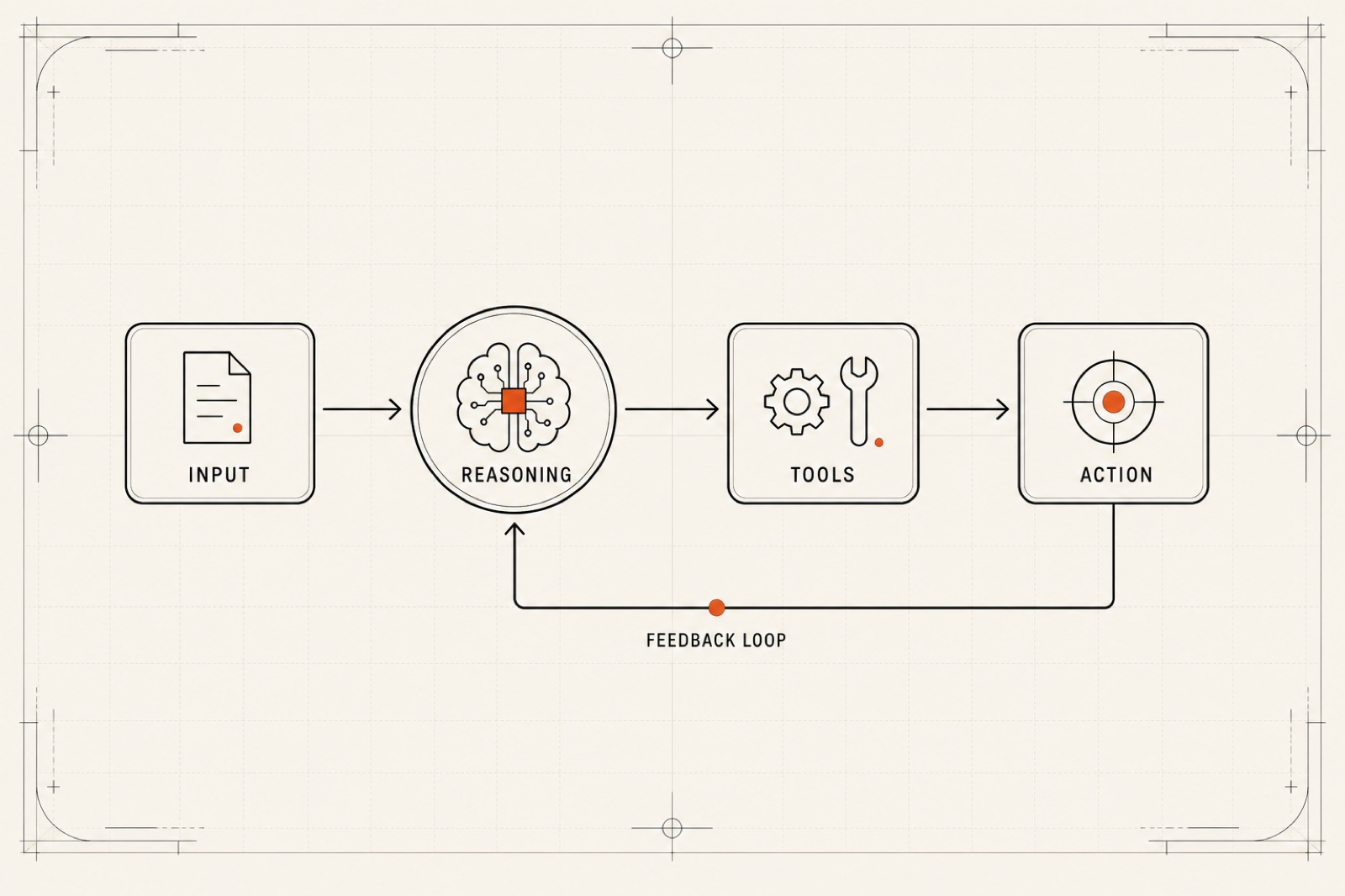
Editorial blueprint of an agent pipeline: input feeds reasoning, which calls tools, produces an action, and closes a feedback loop
Input → Reasoning → Tools → Action → Feedback
Phase01Discover

Discover

We start by understanding the work, not the technology. In a focused two-to-three week engagement we sit with the people who do the process today, watch how it really happens — including the exceptions and workarounds that never make it into a spec — and gather the documents and data an agent would need to rely on. We define what success means in numbers you already care about: resolution rate, turnaround time, error rate, hours returned. If we conclude an agent is the wrong answer, we say so here, before you have spent real money.

  • Workflow mapping
  • Success metrics
  • Data & access audit
  • Risk & feasibility
Phase02Design

Design

With the problem understood, we design the agent as a system. That means deciding how it reasons, which tools it may call, what it retrieves and from where, and — crucially — where a human stays in the loop. We write this down as an architecture your engineers can review and challenge. Alongside it we design the evaluation set: the concrete cases that will define whether the agent is good enough to ship. Designing the test before the build keeps everyone honest and turns "does it feel right?" into a number we can watch.

  • Agent architecture
  • Tool & data design
  • Human-in-the-loop points
  • Evaluation set
Phase03Build

Build

We build in short iterations against the evaluation set, so quality is visible from the first week rather than revealed at the end. Each loop closes the gap: we run the graded cases, read the traces of where the agent went wrong, and fix the reasoning, the retrieval or the guardrail responsible. You see progress as a rising score, not a status update. Everything is real software — reviewed, tested and version-controlled — and we ship behind flags so early access can go to a small, friendly group before anyone else.

  • Iterative development
  • Continuous evaluation
  • Guardrails & tracing
  • Staged rollout
Phase04Operate

Operate

Shipping is the middle of the story, not the end. Agents live in a changing world: your documents update, your customers ask new things, the underlying models get replaced. We monitor quality against the same evaluation set in production, watch cost and latency, and review the cases where the agent deferred to a human to find the next improvement. You can run this yourself with the runbooks and dashboards we hand over, keep us on a support retainer, or move to a hybrid where we stay on call for the hard days. The choice is always yours.

  • Production monitoring
  • Quality regression checks
  • Cost & latency control
  • Runbooks & handover

Principles

What we hold to, in every phase.

These are not slogans. They are the rules that decide what we build and, just as often, what we refuse to.

01

Measure before you trust

An agent earns autonomy by passing tests, not by impressing a stakeholder in a demo. If we cannot measure it, we do not ship it.

02

Fail safe, fail loud

When an agent is unsure, it should stop and ask, not guess. Silent wrong answers are the failure mode we design hardest against.

03

You own the system

Readable code, clear runbooks, no lock-in. Our best outcome is a team that no longer needs us for the everyday.

Ready to start with Discover?

A short, fixed-scope engagement is the lowest-risk way to find out whether an agent belongs in your business.